FortiGate IPsec VPN: Setup, Troubleshooting, and Best Practices
Learn how FortiGate IPsec VPN works, how to configure a site-to-site tunnel, and how to troubleshoot common connection issues.
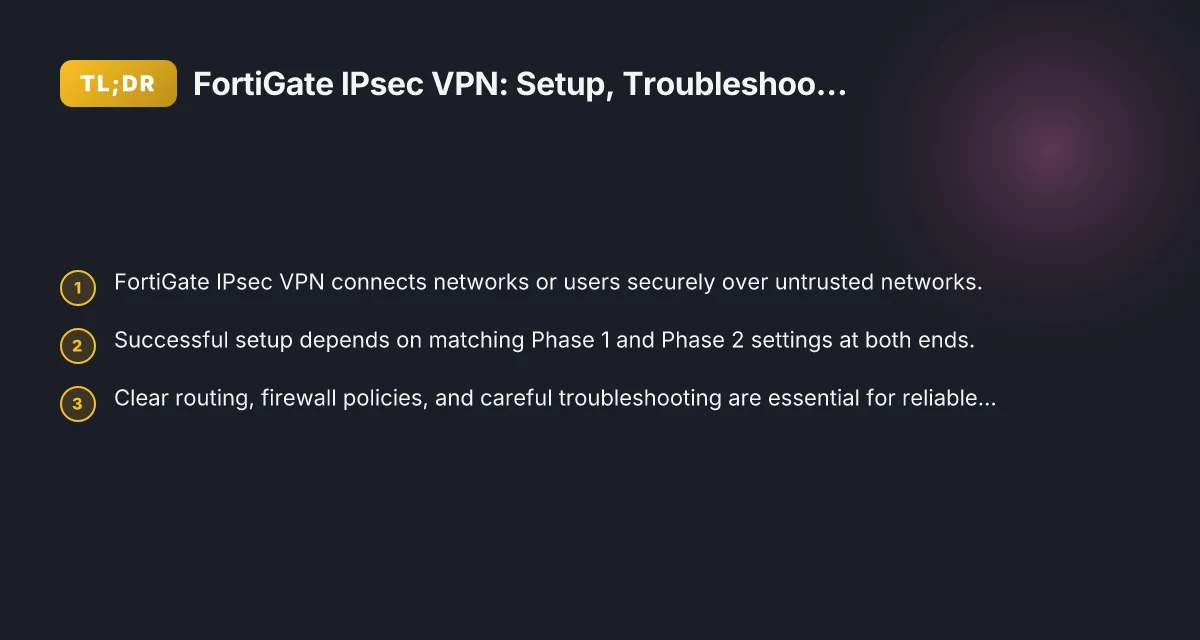
FortiGate IPsec VPN is Fortinet’s way to create encrypted connections between networks or remote users and a FortiGate firewall. For a site-to-site VPN, the tunnel links two locations. For remote access, it gives individual users a secure path into an organization’s network. A reliable configuration requires compatible encryption settings, correct routing, and firewall policies that permit the intended traffic.

Editor's pick: NordVPN — fast, secure VPN — Strong encryption, a no-logs policy and apps for every device. 30-day money-back guarantee. Get NordVPN →
Compare route-based and policy-based FortiGate IPsec VPNs
| Criterion | Route-based VPN | Policy-based VPN |
|---|---|---|
| Traffic handling | Routes through an interface | Matches traffic with firewall policies |
| Configuration model | Tunnel interface and routes | Tunnel and traffic policies |
| Routing flexibility | Supports static or dynamic routing | Tied to defined policies |
| Multiple networks | Easier to manage with routes | Requires matching policies |
| Firewall policy control | Uses policies on the tunnel interface | Policies define tunnel traffic |
| Troubleshooting focus | Routes, interface, and policies | Policy selectors and matching rules |
| Best fit | Flexible or growing networks | Simple, narrowly defined connections |
Compiled November 2026; check the provider's site for current details.
| VPN | Obfuscation | From / month | Plan | Free plan | Refund | Alipay | UnionPay | Crypto | Website opens in China | Trustpilot | |
|---|---|---|---|---|---|---|---|---|---|---|---|
 ZoogVPN | Turn on manually Shadow | $2.49/mo | 27 months: $59.99 | Yes | 7 days | ✓ | ✓ | ✓ | ✓ | Official site blocked; our special link opens (4.4 s) | 4.2/5 (195 reviews) |
 NordVPN | Turn on manually Obfuscated Servers / NordWhisper | $3.49/mo | 27 months: $94.23 | No | 30 days | ? | ✗ | ✓ | ✓ | ✗ Blocked | 4.2/5 (51,628 reviews) |
 ExpressVPN | ✓ On by default all servers | $3.00/mo | 28 months: $84 | No | 30 days | ✗ | ✗ | ✓ | ✗ | ✗ Blocked | 4.4/5 (29,706 reviews) |
 Surfshark | ✓ On by default Camouflage, with OpenVPN | See site | See site | No | 30 days | ✗ | ✗ | ✗ | ✓ | ✗ Blocked | 4.3/5 (31,823 reviews) |
 Proton VPN | Turn on manually Stealth, free plan too | $2.99/mo | 12 months: $35.88 | Yes | 30 days | ✗ | ✗ | ✗ | ✓ | ✗ Blocked | 2.1/5 (1,040 reviews) |
 Astrill VPN | Turn on manually StealthVPN / OpenWeb | $12.50/mo | 24 months: $300 | No | See site | ✗ | ✗ | ✗ | ✓ | ✗ Blocked | 1.3/5 (110 reviews) |
 Private Internet Access | Turn on manually Shadowsocks, OpenVPN only | $2.03/mo | 40 months: $81.2 | No | 30 days | ✗ | ✗ | ✗ | ✗ | ✗ Blocked | 4.2/5 (11,033 reviews) |
 CyberGhost | Turn on manually selected servers | $2.19/mo | 28 months: $61.32 | No | 45 days | ✗ | ✗ | ✗ | ✓ | ✗ Blocked | 4.0/5 (24,178 reviews) |
 PureVPN | Turn on manually switch to OpenVPN | $1.69/mo | 60 months: $101.55 | No | 31 days | ? | ? | ✗ | ✓ | ✗ Blocked | 4.4/5 (17,994 reviews) |
 AdGuard VPN | ✓ On by default TrustTunnel | $2.99/mo | 24 months: $71.76 | Yes | 30 days | ✓ | ✗ | ✓ | ✓ | Official site blocked; our special link opens (3.7 s) | 4.3/5 (290 reviews) |
 Mullvad | Turn on manually QUIC / Shadowsocks / LWO | $5.61/mo | €5/mo | No | 14 days | ✗ | ✗ | ✗ | ✓ | ✗ Blocked | 3.2/5 (192 reviews) |
 Windscribe | Turn on manually Stealth / WStunnel | $5.75/mo | 12 months: $69 | Yes | See site | ✗ | ✗ | ✗ | ✓ | ✗ Blocked | 4.7/5 (13,355 reviews) |
 StrongVPN | Turn on manually Scramble, OpenVPN TCP | See site | See site | No | 30 days | ✓ | ✗ | ✗ | ✗ | ✗ Blocked | 4.4/5 (2,695 reviews) |
 LightXtreme 闪连 | Not listed | $7.08/mo | 12 months: $84.99 | Yes | 30 days | ✓ | ✓ | ✓ | ✓ | ✓ Yes (3.5 s) | No page |
Prices checked 2026-11-10 on each vendor's pricing page (cheapest long plan, USD). Check the vendor's checkout for the final price.
Obfuscation checked 2026-11-14 on each vendor's site and help center: "on by default" = nothing to set; "turn on manually" = switch protocol or mode in settings; "not listed" = the vendor describes no obfuscation.
Payment methods checked 2026-11-10 on each vendor's payment pages: all 14 take cards and PayPal; ✗ = not listed, ? = the vendor's own pages disagree.
China access: whether the official website opens from mainland China networks (tests the website only, not the VPN connection). Last checked 2026-11-18 01:02 Beijing time.
Trustpilot score and review count checked 2026-11-10.
What FortiGate IPsec VPN does
IPsec protects IP traffic by authenticating the VPN peers and encrypting data as it travels across the internet or another untrusted network. FortiGate appliances can establish IPsec tunnels with other FortiGate devices and with compatible third-party gateways.
Common uses include:
- Site-to-site connectivity: Join office, data center, cloud, or branch networks.
- Remote access: Allow approved users to reach internal resources through a VPN client.
- Secure cloud connections: Connect a FortiGate network to a cloud VPN gateway.
- Redundant connectivity: Provide backup tunnels or multiple paths between locations.
An IPsec tunnel has two main negotiation stages. Phase 1, also called IKE, authenticates the peers and establishes a secure management channel. Phase 2 negotiates the protection for the actual data traffic, including the networks that can communicate through the tunnel. Both peers must use compatible parameters.
Site-to-site setup: the essential steps
Exact menu names and available options can vary by FortiOS version, model, and configuration. Use the GUI or CLI appropriate to your device, and check the documentation for your installed release. VPN FortiGate: How It Works and How to Choose the Right Setup
Before configuring the tunnel, collect the information for both sides:
- The public IP address or hostname of each VPN peer
- The local and remote network ranges
- Authentication method and credentials, such as a pre-shared key or certificates
- Compatible Phase 1 and Phase 2 proposals
- Any required IKE version, NAT traversal, and lifetime settings
Then work through these steps:
- Create the Phase 1 interface. Set the remote gateway, authentication method, IKE version, encryption and authentication algorithms, and Diffie–Hellman group. Use a strong, unique pre-shared key if that method is selected.
- Configure Phase 2 selectors. Specify the local and remote subnets that should travel through the tunnel, along with matching encryption and integrity settings. The selectors must correspond to the peer’s configuration.
- Add routing. Create a route for the remote network that points to the IPsec interface, or configure dynamic routing if the design requires it.
- Create firewall policies. Allow traffic from the local network to the remote network through the tunnel. Add a corresponding policy for traffic returning from the tunnel when required by the design. Avoid overly broad access rules.
- Test the connection. Bring up the tunnel, check its status, and test traffic between specific hosts in the permitted subnets.
For route-based VPNs, FortiGate represents the tunnel as an interface. This approach commonly supports flexible routing and policy control. A policy-based configuration may be available in some environments, but should be chosen only when it fits the network design and peer requirements.
Route-based and policy-based VPNs
Choosing the right style affects how traffic is selected and managed. Com.NordVPN.Android: What It Is and How to Use the NordVPN Android App
| Feature | Route-based VPN | Policy-based VPN |
|---|---|---|
| Traffic selection | Routing sends matching traffic to the tunnel interface | Firewall policies define which traffic uses IPsec |
| Flexibility | Suits changing routes, multiple subnets, and dynamic routing | Can suit simpler, fixed traffic selectors |
| Operations | Tunnel interface is visible in routing and policy workflows | Traffic matching may be more closely tied to VPN rules |
| Best fit | Most new deployments and more complex networks | Specific legacy or interoperability requirements |
A route-based VPN is often the practical choice for new FortiGate deployments because it works naturally with routes and firewall policies. However, compatibility with the remote peer matters more than preference: confirm that both devices support the intended mode and selectors.
Site-to-site IPsec VPN setup checklist
| Step | What to configure | What to verify | Common issue |
|---|---|---|---|
| 1. Define endpoints | Peer addresses and device roles | Peers can reach each other | Incorrect peer address |
| 2. Set authentication | Pre-shared key or certificates | Both peers use matching credentials | Authentication mismatch |
| 3. Match phase 1 | IKE version and proposals | Settings agree at both ends | Proposal mismatch |
| 4. Match phase 2 | Encryption, integrity, and selectors | Protected networks match | Selector mismatch |
| 5. Configure routing | Routes to remote networks | Remote networks use the tunnel | Missing or incorrect route |
| 6. Add firewall policies | Permit intended traffic | Policy allows the right interfaces and services | Policy blocks traffic |
| 7. Test and monitor | Generate traffic and inspect tunnel status | Tunnel establishes and traffic passes | Tunnel is up but traffic fails |
Compiled November 2026; check the provider's site for current details.
Security and configuration best practices
A tunnel can connect successfully and still be insecure or unreliable if its settings are too permissive. Apply these practices: Certificate Validation Failure Cisco VPN: Causes and Fixes
- Use current, mutually supported IKE and encryption algorithms. Avoid obsolete options where possible.
- Use a long, random pre-shared key or certificate-based authentication.
- Limit Phase 2 selectors, routes, and firewall policies to the networks and services that need access.
- Keep FortiOS and VPN clients updated according to your organization’s change process.
- Use unique credentials for each tunnel and protect configuration backups.
- Consider monitoring, logging, and alerting for tunnel status and unusual traffic.
- Plan for high availability or a backup tunnel when the connection supports critical services.
For remote-access deployments, define who may connect, which internal resources they can reach, and how authentication is protected. Enforce the organization’s identity and endpoint security requirements rather than treating VPN connectivity as unrestricted network access.
Troubleshooting common problems
Start by checking whether Phase 1 is established, then whether Phase 2 is up and traffic is passing. The point where negotiation stops often narrows the cause.
Phase 1 will not establish
Check that both peers use the correct public addresses, IKE version, authentication method, pre-shared key, and Phase 1 proposal. Confirm that the internet path permits the required IPsec traffic. When a peer is behind NAT, NAT traversal may be necessary.
Phase 1 is up, but Phase 2 fails
Compare the local and remote selectors, encryption and authentication proposals, and key lifetimes. A mismatch in even one required setting can prevent Phase 2 from negotiating. FortiClient VPN Online Installer: How to Download and Install It Safely
The tunnel is up, but traffic does not pass
Check the route to the remote subnet, firewall policies in the correct direction, and the source and destination addresses of the test traffic. Also verify that local hosts use the FortiGate as their gateway and that another device is not blocking the traffic.
Only one direction works
Review return routes and policies on both networks. Check for overlapping subnet ranges, asymmetric routing, and NAT rules that unexpectedly change addresses. If NAT is required, confirm that it is applied consistently with the tunnel design.
Use FortiGate’s VPN status and event logs to identify negotiation errors. For deeper diagnosis, FortiOS diagnostic tools can display IKE exchanges and packet flow, but debug output may contain sensitive details. Limit its use, capture only what is needed, and disable debugging afterward. Command syntax and diagnostic behavior can vary between FortiOS releases.
Troubleshoot common FortiGate IPsec VPN symptoms Free VPN Extension for Microsoft Edge: What to Choose and How to Stay Safe
| Symptom | Check first | Likely cause | Next action |
|---|---|---|---|
| Tunnel does not establish | Peer reachability and IKE logs | Peer settings or authentication mismatch | Compare phase 1 settings |
| Phase 1 succeeds, phase 2 fails | Proposals and traffic selectors | Phase 2 mismatch | Align proposals and selectors |
| Tunnel is up, no traffic passes | Routes and firewall policies | Missing route or blocked traffic | Verify routing and policy matches |
| Only one direction works | Policies and return route | Asymmetric routing or one-way policy | Check both traffic directions |
| Some networks work, others do not | Selectors and routes | Network omitted from configuration | Add matching selectors and routes |
| Tunnel drops intermittently | Logs and peer connectivity | Unstable link or mismatched timers | Check connectivity and agreed timers |
| Name-based traffic fails | DNS settings and reachability | DNS traffic is not routed or permitted | Verify DNS path and policy |
Compiled November 2026; check the provider's site for current details.
Recommendation
For most new deployments, use a route-based FortiGate IPsec VPN with narrowly defined selectors, routes, and firewall policies. Confirm every Phase 1 and Phase 2 setting with the remote administrator, then test access in both directions and monitor the tunnel after rollout.