VPN SSL BWG Online Service: How It Works and What to Check
Learn what a VPN SSL BWG online service may offer, how to assess its safety, and what to verify before connecting.
A VPN SSL BWG online service generally refers to a web-based or client-based SSL VPN that lets authorized users securely access an organization’s network over the internet. However, “BWG” is not enough to identify a particular provider or service. Confirm what the initials refer to and use only access details supplied through the organization’s official website, IT team, or administrator.
An SSL VPN uses encryption to protect traffic between your device and a VPN gateway. Depending on how it is configured, it may provide access to internal websites, applications, or a broader set of network resources. Before entering credentials or installing software, check that the service is legitimate, that the connection is configured correctly, and that its access rules fit your needs.
| VPN | Obfuscation | From / month | Plan | Free plan | Refund | Alipay | UnionPay | Crypto | Website opens in China | Trustpilot | |
|---|---|---|---|---|---|---|---|---|---|---|---|
 ZoogVPN | Turn on manually Shadow | $2.49/mo | 27 months: $59.99 | Yes | 7 days | ✓ | ✓ | ✓ | ✓ | Official site blocked; our special link opens (4.4 s) | 4.2/5 (195 reviews) |
 NordVPN | Turn on manually Obfuscated Servers / NordWhisper | $3.49/mo | 27 months: $94.23 | No | 30 days | ? | ✗ | ✓ | ✓ | ✗ Blocked | 4.2/5 (51,628 reviews) |
 ExpressVPN | ✓ On by default all servers | $3.00/mo | 28 months: $84 | No | 30 days | ✗ | ✗ | ✓ | ✗ | ✗ Blocked | 4.4/5 (29,706 reviews) |
 Surfshark | ✓ On by default Camouflage, with OpenVPN | See site | See site | No | 30 days | ✗ | ✗ | ✗ | ✓ | ✗ Blocked | 4.3/5 (31,823 reviews) |
 Proton VPN | Turn on manually Stealth, free plan too | $2.99/mo | 12 months: $35.88 | Yes | 30 days | ✗ | ✗ | ✗ | ✓ | ✗ Blocked | 2.1/5 (1,040 reviews) |
 Astrill VPN | Turn on manually StealthVPN / OpenWeb | $12.50/mo | 24 months: $300 | No | See site | ✗ | ✗ | ✗ | ✓ | ✗ Blocked | 1.3/5 (110 reviews) |
 Private Internet Access | Turn on manually Shadowsocks, OpenVPN only | $2.03/mo | 40 months: $81.2 | No | 30 days | ✗ | ✗ | ✗ | ✗ | ✗ Blocked | 4.2/5 (11,033 reviews) |
 CyberGhost | Turn on manually selected servers | $2.19/mo | 28 months: $61.32 | No | 45 days | ✗ | ✗ | ✗ | ✓ | ✗ Blocked | 4.0/5 (24,178 reviews) |
 PureVPN | Turn on manually switch to OpenVPN | $1.69/mo | 60 months: $101.55 | No | 31 days | ? | ? | ✗ | ✓ | ✗ Blocked | 4.4/5 (17,994 reviews) |
 AdGuard VPN | ✓ On by default TrustTunnel | $2.99/mo | 24 months: $71.76 | Yes | 30 days | ✓ | ✗ | ✓ | ✓ | Official site blocked; our special link opens (3.7 s) | 4.3/5 (290 reviews) |
 Mullvad | Turn on manually QUIC / Shadowsocks / LWO | $5.61/mo | €5/mo | No | 14 days | ✗ | ✗ | ✗ | ✓ | ✗ Blocked | 3.2/5 (192 reviews) |
 Windscribe | Turn on manually Stealth / WStunnel | $5.75/mo | 12 months: $69 | Yes | See site | ✗ | ✗ | ✗ | ✓ | ✗ Blocked | 4.7/5 (13,355 reviews) |
 StrongVPN | Turn on manually Scramble, OpenVPN TCP | See site | See site | No | 30 days | ✓ | ✗ | ✗ | ✗ | ✗ Blocked | 4.4/5 (2,695 reviews) |
 LightXtreme 闪连 | Not listed | $7.08/mo | 12 months: $84.99 | Yes | 30 days | ✓ | ✓ | ✓ | ✓ | ✓ Yes (3.5 s) | No page |
Prices checked 2026-11-10 on each vendor's pricing page (cheapest long plan, USD). Check the vendor's checkout for the final price.
Obfuscation checked 2026-11-14 on each vendor's site and help center: "on by default" = nothing to set; "turn on manually" = switch protocol or mode in settings; "not listed" = the vendor describes no obfuscation.
Payment methods checked 2026-11-10 on each vendor's payment pages: all 14 take cards and PayPal; ✗ = not listed, ? = the vendor's own pages disagree.
China access: whether the official website opens from mainland China networks (tests the website only, not the VPN connection). Last checked 2026-11-18 01:02 Beijing time.
Trustpilot score and review count checked 2026-11-10.
Editor's pick: NordVPN — fast, secure VPN — Strong encryption, a no-logs policy and apps for every device. 30-day money-back guarantee. Get NordVPN →
Compare VPN access options
| Option | Access method | Typical use | Key check | Main trade-off |
|---|---|---|---|---|
| SSL VPN portal | Web browser | Web apps and files | Confirm the portal URL | Limited app compatibility |
| SSL VPN client | Installed software | Network and desktop apps | Verify supported devices | Requires installation |
| IPsec VPN | Installed software | Broad network access | Check firewall compatibility | May need more setup |
| Remote desktop gateway | Remote desktop client | A managed work computer | Confirm device and account controls | Access is limited to the remote machine |
| Direct public access | Browser or app | Public-facing services | Check HTTPS and account security | No private-network access |
| No remote connection | Not applicable | Sensitive work on-site | Confirm an approved alternative | Cannot work remotely |
Compiled November 2026; check the provider's site for current details.
What an SSL VPN does
SSL VPN is a common term for remote access VPN technology that uses TLS encryption, the same broad family of protocols used to secure modern HTTPS connections. A user connects to a gateway, typically through a browser or a dedicated VPN application, and authenticates before being granted access.
The specific access provided depends on the service:
- A portal-based VPN may give access to selected internal web applications through a browser.
- A client-based VPN may route some or all device traffic through the organization’s network.
- A limited-access VPN may permit only approved systems, such as a company intranet or a particular business application.
These approaches are not interchangeable. A portal may not protect all internet traffic from your device, while a full-tunnel client could route much more through the gateway. Review the setup instructions to understand what is covered.
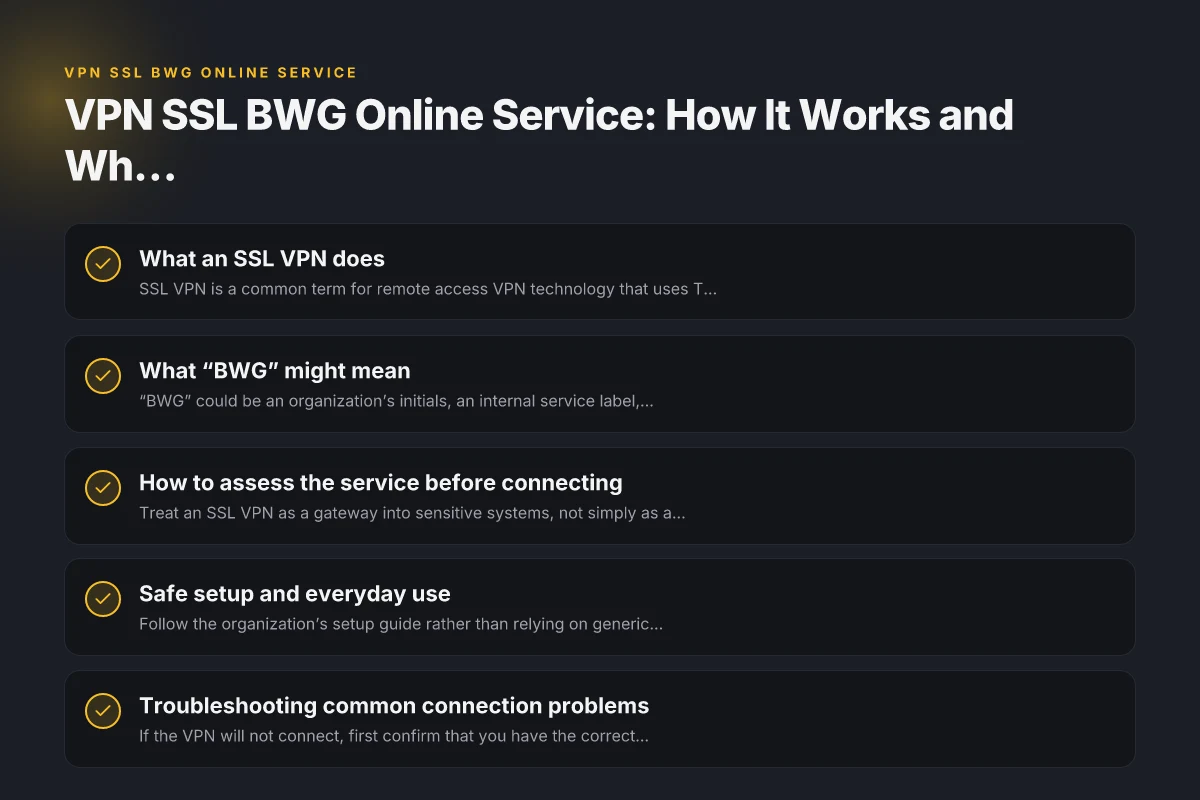
What “BWG” might mean
“BWG” could be an organization’s initials, an internal service label, a vendor reference, or part of a search phrase. The keyword alone does not establish the service’s owner, address, software, or legitimacy. Avoid assuming that a website or download is official just because it uses the same initials. VPN Extension for Microsoft Edge: How to Choose and Use One
To identify the correct service, check:
- The exact organization or provider name.
- The official VPN address supplied by your employer, school, or service administrator.
- Whether the service requires a browser, a particular VPN client, or both.
- Whether the instructions are current and intended for your device.
- Who to contact if the login page or installation prompt looks unfamiliar.
Do not search for a login page and then choose a result based only on its name. Attackers can create lookalike pages that imitate real sign-in portals.
Assess an SSL VPN service before connecting
| Check | Good sign | Warning sign | How to verify |
|---|---|---|---|
| Provider identity | Organization confirms the service | Unknown or unverified operator | Ask your IT team |
| Portal address | Exact URL supplied by a trusted source | Link arrives unexpectedly | Confirm the address independently |
| Login process | Expected sign-in and MFA | Requests for passwords by email | Use the official login page |
| “BWG” meaning | Defined by the service owner | Meaning is assumed or unclear | Ask what BWG refers to |
| Privacy terms | Data collection and retention are explained | No clear privacy information | Review the provider’s policy |
| Device support | Your OS and browser are listed | Compatibility is unspecified | Check official setup guidance |
| Security updates | Client and instructions are maintained | Outdated downloads or guidance | Check the official support page |
| Help channel | Recognized support contact is available | Support details cannot be verified | Contact your organization directly |
Compiled November 2026; check the provider's site for current details. Free VPN for Edge Extension: How to Choose One Safely
How to assess the service before connecting
Treat an SSL VPN as a gateway into sensitive systems, not simply as a privacy tool. A legitimate remote-access service should have a clear owner, documented access instructions, and a support contact.
| What to check | What to look for |
|---|---|
| Official access point | A URL or app link provided by the organization through a trusted channel |
| Connection security | A valid certificate and no browser warnings; confirm the address is correct |
| Authentication | Individual accounts and, where available, multifactor authentication |
| Software source | VPN client downloads from the organization or the software publisher’s official site |
| Privacy and logging | Clear information about what activity may be logged and who can access it |
| Support | A known IT or provider contact for reporting login and security issues |
A padlock icon or HTTPS address is not proof that a site is operated by the organization you expect. Check the full domain and confirm it through an independent, trusted channel. Never bypass a certificate warning unless your administrator has verified the cause and provided safe instructions.
Safe setup and everyday use
Follow the organization’s setup guide rather than relying on generic steps found online. VPN configuration varies by provider, device, and access policy. If an app is required, install it only from an approved source and check that its publisher matches the instructions.
For safer use: Free VPN Edge Extension: How to Choose One for Microsoft Edge
- Use a unique, strong password and enable multifactor authentication if offered.
- Do not share your VPN account or approve unexpected authentication prompts.
- Connect only on devices that meet the organization’s security requirements.
- Keep your operating system, browser, and VPN application updated.
- Disconnect when remote access is no longer needed, especially on a shared device.
- Report unusual login pages, repeated sign-in prompts, or unexpected connection failures.
A VPN does not make every activity anonymous or automatically secure an infected device. The service operator may be able to record connection details, and websites or apps may still identify you through your account or other signals. Follow your organization’s policies and avoid using a work or school VPN for unrelated activity unless permitted.
Troubleshooting common connection problems
If the VPN will not connect, first confirm that you have the correct official address and that your account is active. Check your internet connection, device date and time, and whether the VPN client needs an update. A password reset or account unlock may need to go through the organization’s normal support process.
If you see a certificate warning, an unfamiliar login screen, or a request to install software from an unknown source, stop. Do not enter your password or continue with the installation. Contact the service administrator using a phone number, support portal, or email address you already trust.
Some networks block VPN connections, and some organizations restrict access by device, location, or user role. These restrictions are not necessarily a fault with your device. Ask the administrator for the approved remedy rather than trying to evade access controls or changing security settings. VPN Keeps Turning On iPhone? Causes and Fixes
Choose a safe setup and troubleshooting action
| Situation | First action | Next check | Avoid |
|---|---|---|---|
| First-time setup | Follow official instructions | Confirm the portal URL | Unofficial downloads |
| Login rejected | Re-enter credentials carefully | Check account status and MFA | Repeated guessing |
| MFA not received | Check approved MFA methods | Confirm device time and signal | Sharing a one-time code |
| Client will not connect | Check internet access | Review client and OS support | Disabling security software |
| Connection drops | Try a stable network | Check for service notices | Using an unknown public proxy |
| Sites or apps fail | Confirm VPN connection status | Check access permissions | Assuming all traffic is routed |
| Certificate warning appears | Stop and verify the address | Contact the service owner | Bypassing the warning |
| Problem persists | Record the error message | Contact verified support | Sending passwords or MFA codes |
Compiled November 2026; check the provider's site for current details.
Recommendation
Use a VPN SSL BWG online service only after confirming what “BWG” refers to and verifying the official gateway with the organization that manages it. Follow its documented setup, use multifactor authentication where available, and stop if the address, certificate, or software source cannot be verified.