Proxy Server: What It Is, How It Works, and When to Use One

Learn what a proxy server does, explore common types, and choose one that fits your privacy, security, and performance needs.
A proxy server sits between your device and the internet, forwarding requests to websites or other online services and returning their responses. Depending on how it is configured, it can help manage network access, filter content, cache data, or make a service see the proxy’s IP address instead of your own. A proxy is useful for specific privacy, security, and business tasks, but it is not a complete security solution.
Editor's pick: NordVPN — fast, secure VPN — Strong encryption, a no-logs policy and apps for every device. 30-day money-back guarantee. Get NordVPN →
Compare common proxy types by how they handle traffic and when they fit
| Proxy type | Traffic covered | Typical use | Main advantage | Main limitation |
|---|---|---|---|---|
| HTTP proxy | Web traffic | Browsing websites | Simple web filtering | Does not protect other app traffic |
| HTTPS proxy | Encrypted web traffic | Secure browsing | Supports encrypted connections | Does not cover all device traffic |
| SOCKS proxy | Many types of app traffic | Apps, downloads, and games | Flexible traffic support | Encryption depends on the app or service |
| Transparent proxy | Selected traffic, often without user setup | Network filtering and caching | Easy for administrators to deploy | Users may not control its use |
| Forward proxy | Client requests going to the internet | Access control and shared networks | Can manage outbound access | Depends on proxy operator |
| Reverse proxy | Requests going to a server | Load balancing and server protection | Helps manage incoming traffic | Usually serves website operators, not individual users |
| Residential proxy | Requests routed through residential IP addresses | Location-specific access | IPs resemble regular household connections | Provider practices and consent may vary |
| Datacenter proxy | Requests routed through data center IP addresses | High-volume automated tasks | Often fast and easy to scale | IPs may be easier to identify as proxy traffic |
Compiled November 2026; check the provider's site for current details.
What a proxy server does
When you connect directly to a website, your device sends a request to that website, which responds to your device. With a proxy, the request first goes to the proxy server. The proxy then contacts the destination and relays the response.
In a typical setup, the process is:
- Your browser or app connects to the proxy.
- The proxy forwards the request to the destination.
- The destination responds to the proxy.
- The proxy relays the response to your device.
The website may see the proxy’s IP address rather than your device’s public IP address. However, a proxy does not necessarily hide all identifying information. Websites can still use account details, cookies, browser settings, and other signals to recognize or track users.
Proxies may also apply rules to traffic. A company, for example, can use one to restrict access to certain sites or log network activity. A caching proxy can store copies of frequently requested resources and serve them more quickly. NordVPN Download: How to Get and Install the App Safely
Common types of proxy servers
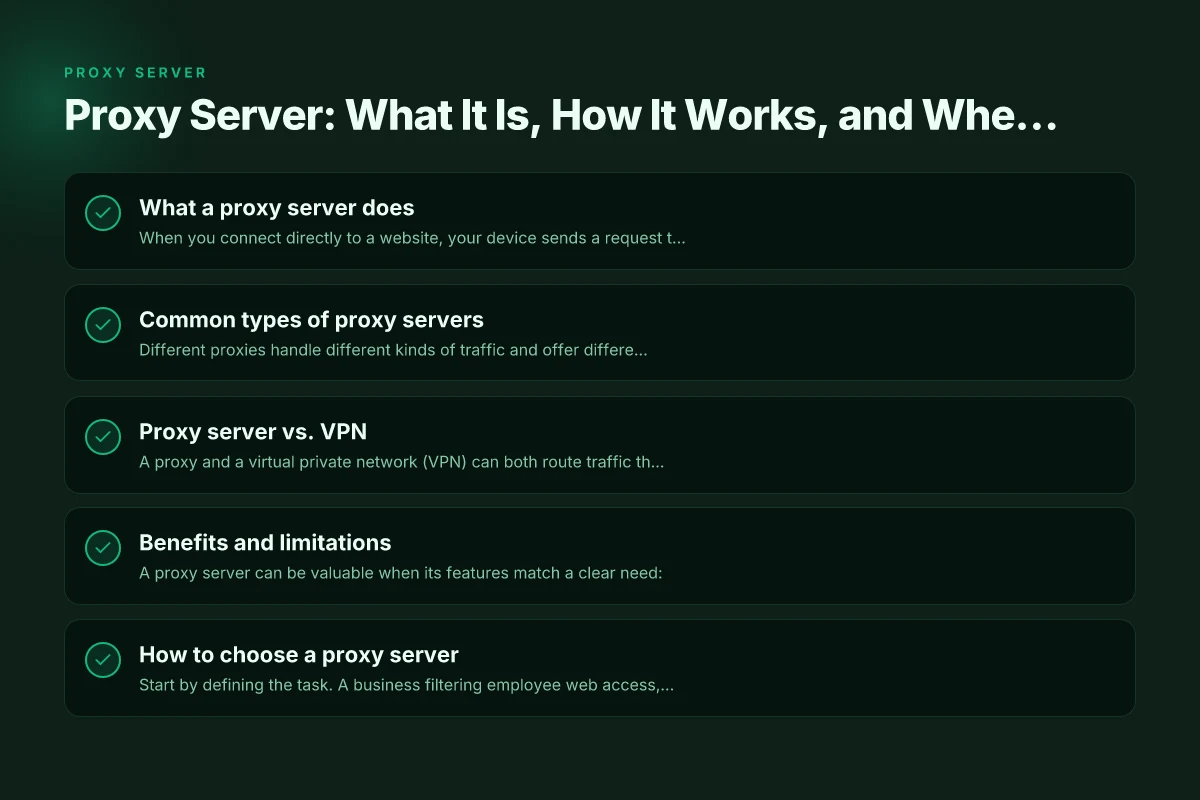
Different proxies handle different kinds of traffic and offer different features. The right choice depends on what you need to do.
- Forward proxy: Sits between users and the internet. Organizations commonly use forward proxies to enforce browsing policies, monitor traffic, or manage outbound connections.
- Reverse proxy: Sits in front of web servers and handles incoming requests. Website operators use reverse proxies for load balancing, caching, and security controls.
- HTTP proxy: Handles web traffic that uses HTTP. Its capabilities depend on its configuration and whether it supports secure HTTPS connections through tunneling.
- SOCKS proxy: Can relay various types of network traffic, not just web requests. It typically does not inspect or interpret the traffic itself.
- Transparent proxy: Intercepts or manages traffic without requiring users to configure a proxy manually. It may be used on managed networks for filtering or caching.
- Residential or datacenter proxy: Describes the kind of IP address used by the proxy. Residential IPs are associated with internet service providers, while datacenter IPs come from hosting infrastructure. Their suitability and reliability vary by provider and use case.
A proxy can be configured on a device, in an application, or across a whole network. Some services provide a browser extension or app, while others require you to enter connection details such as a server address, port, and login credentials.
Proxy server vs. VPN for common privacy and connectivity needs
| Comparison point | Proxy server | VPN |
|---|---|---|
| Traffic coverage | Often one app or traffic type | Usually device-wide |
| IP address masking | Yes, for routed traffic | Yes, for tunneled traffic |
| Connection encryption | Depends on proxy type | Typically encrypts the tunnel |
| Setup scope | May be configured per app | Often configured for the device |
| Performance impact | Depends on proxy and route | Depends on provider and route |
| Best fit | App-specific routing or filtering | Broader protection on public networks |
| Limits | May leave other traffic exposed | Does not guarantee anonymity |
| Provider visibility | Provider may see routed requests | VPN provider may see connection metadata |
Compiled November 2026; check the provider's site for current details. Cj VPN login: How to Access Your Account Safely
Proxy server vs. VPN
A proxy and a virtual private network (VPN) can both route traffic through another server, but they are not interchangeable. In particular, a proxy should not be assumed to encrypt everything between your device and the proxy.
| Feature | Proxy server | VPN |
|---|---|---|
| Typical scope | One app, browser, or selected traffic | Often routes most device traffic |
| IP address shown to destination | Usually the proxy’s address | Usually the VPN server’s address |
| Encryption | Depends on the proxy and connection; not guaranteed | Normally encrypts the tunnel between device and VPN server |
| Common uses | Filtering, caching, testing, app-specific routing | Protecting traffic on untrusted networks and routing device traffic |
| Setup | May be configured per app or network | Usually requires a VPN app or system profile |
HTTPS encrypts the connection between your browser and a website, regardless of whether a proxy is involved, though the proxy may still see connection details such as the destination domain in some configurations. A VPN’s encrypted tunnel and a website’s HTTPS connection serve different purposes. For sensitive activity, understand which parts of the connection are encrypted and who operates the service.
Benefits and limitations
A proxy server can be valuable when its features match a clear need:
- Network control: Schools and businesses can apply access rules to managed devices.
- Performance: Caching may reduce repeated downloads and speed up access to commonly requested content.
- IP-based testing: Developers and organizations can check how websites or services behave from different network locations, where permitted.
- Traffic management: Reverse proxies can distribute incoming requests across multiple servers and help absorb traffic spikes.
- App-specific routing: A proxy can route one browser or application without changing the network settings for everything else.
There are important limitations. A proxy may record your IP address, destinations, or other metadata. The proxy operator could potentially inspect unencrypted traffic, and a misconfigured service may expose information rather than protect it. Free proxies can be especially risky: some are slow, unreliable, supported by intrusive advertising, or operated with unclear privacy practices. Proton VPN Download: How to Get and Install the Official App
A proxy also does not make unlawful or unauthorized activity acceptable. Follow the rules of the network, the proxy service, and the websites or services you access.
How to choose a proxy server
Start by defining the task. A business filtering employee web access, a developer testing a website, and an individual routing one app have different requirements.
Before choosing a service or configuring your own, consider:
- Purpose: Confirm that the proxy supports the protocols and applications you need.
- Privacy policy: Check what the operator collects, how long it keeps logs, and whether it shares data.
- Security: Look for secure connections, strong authentication, and clear guidance on configuration.
- Reliability: Review uptime, speed, support, and the provider’s approach to service disruptions.
- IP source and location: Make sure the available IP types and locations are appropriate and permitted for your task.
- Cost and terms: Understand pricing, bandwidth limits, acceptable-use rules, and cancellation conditions.
- Management needs: For organizations, check whether the service provides access controls, reporting, and administrative tools.
Avoid entering passwords or sensitive information through an unknown proxy. Use HTTPS, keep software updated, and verify that your proxy settings point to the intended server. On a work or school network, follow the administrator’s instructions rather than installing an unapproved service. Free VPN Extension for Edge Browser: How to Choose One Safely
Choose a proxy service by matching requirements to checks
| Requirement | What to check | Suitable option | Main trade-off |
|---|---|---|---|
| Browse through a specific app | App supports proxy settings | App-level proxy | Other apps may use direct connections |
| Route most device traffic | Device supports proxy routing | System-wide proxy or VPN | Setup and compatibility vary |
| Protect web connections | HTTPS support and secure configuration | HTTPS proxy | Coverage may be limited to web traffic |
| Handle non-web app traffic | SOCKS support and app compatibility | SOCKS proxy | Encryption may need separate handling |
| Access a particular region | Available exit locations | Proxy with matching location | Location claims may not ensure access |
| Manage a business network | Access controls and logging options | Managed forward proxy | Requires administration |
| Protect a website’s incoming traffic | Reverse-proxy features | Reverse proxy | Usually requires server-side configuration |
| Evaluate trustworthiness | Ownership, privacy policy, and support | Transparent, reputable provider | Free services may have unclear practices |
Compiled November 2026; check the provider's site for current details.
Recommendation
Use a proxy server when you need a specific function such as network filtering, caching, reverse-proxy protection, or routing traffic from one application. Choose a trusted provider or a properly managed server, and verify its logging and security practices. If your goal is to protect traffic across a device, especially on public Wi-Fi, a reputable VPN may be a better fit, but no routing tool replaces careful security habits.